Monday, July 21, 2008
AP English Literature and Composition 2008-2009
If you're looking for Mr. Cook's AP English blog for 2008-2009 go here.

Tuesday, May 20, 2008
Re-Contextualizing & Re-Imagining a Text: Heart of Darkness becomes Apocalypse Now!
[Apocalypse Now! contains some adult language and violence. These clips are intended for educational purposes: analysis of the use of Joseph Conrad's Heart of Darkness by Francis Ford Coppola (director) and John Milius (writer) in Apocalypse Now!]
1. Senseless Violence Directed toward Natives and the Land (the unknown)
Heart of Darkness: Marlow sees an attack on the natives though he can see no natives.
‘…assuring me most earnestly there was a camp of natives – he called them enemies! – hidden out of sight somewhere.’ (page 15)
Apocalypse Now! Opening Scene
Willard seems to remember an attack on the countryside. As in the scene from Heart of Darkness no enemy is seen but the land, the forest is destroyed.
2.
Heart of Darkness Marlow with the Russian Trade Meets Kurtz
"I could not hear a sound, but through my glasses I saw the thin arm extended commandingly, the lower jaw moving, the eyes of that apparition shining darkly far in its bony head that nodded with grotesque jerks. Kurtz -- Kurtz -- that means short in German -- don't it? Well, the name was as true as everything else in his life -- and death. He looked at least seven feet long. His covering had fallen off, and his body emerged from it pitiful and appalling as from a winding-sheet. I could see the cage of his ribs all astir, the bones of his arm waving. It was as though an animated image of death carved out of old ivory had been shaking its hand with menaces at a motionless crowd of men made of dark and glittering bronze. I saw him open his mouth wide -- it gave him a weirdly voracious aspect, as though he had wanted to swallow all the air, all the earth, all the men before him. A deep voice reached me faintly. He must have been shouting. He fell back suddenly."
The Manager talks to Marlow of Kurtz's "unsound methods"
"The manager came out. He did me the honour to take me under the arm and lead me aside. 'He is very low, very low,' he said. He considered it necessary to sigh, but neglected to be consistently sorrowful. 'We have done all we could for him -- haven't we? But there is no disguising the fact, Mr. Kurtz has done more harm than good to the Company. He did not see the time was not ripe for vigorous action. Cautiously, cautiously -- that's my principle. We must be cautious yet. The district is closed to us for a time. Deplorable! Upon the whole, the trade will suffer. I don't deny there is a remarkable quantity of ivory -- mostly fossil. We must save it, at all events -- but look how precarious the position is -- and why? Because the method is unsound.' 'Do you,' said I, looking at the shore, 'call it "unsound method?"' 'Without doubt,' he exclaimed hotly. 'Don't you?' . . . 'No method at all,' I murmured after a while. 'Exactly,' he exulted. 'I anticipated this. Shows a complete want of judgment. It is my duty to point it out in the proper quarter.' 'Oh,' said I, 'that fellow -- what's his name? -- the brickmaker, will make a readable report for you.' He appeared confounded for a moment. It seemed to me I had never breathed an atmosphere so vile, and I turned mentally to Kurtz for relief -- positively for relief. 'Nevertheless I think Mr. Kurtz is a remarkable man,' I said with emphasis. He started, dropped on me a heavy glance, said very quietly, 'he WAS,' and turned his back on me. My hour of favour was over; I found myself lumped along with Kurtz as a partisan of methods for which the time was not ripe: I was unsound! Ah! but it was something to have at least a choice of nightmares.
Apocalypse now Willard [Marlow] meets Kurtz who speaks of the beauty of gardenias, asks if Willard thinks his "methods" are "unsound," and says Williard was sent by "grocery clerks to collect a bill" (an allusion to the Manager?)
3.
Kurtz reads "Hollow Man" by T.S. Eliot (the epigraph to this poem is taken from Heart of Darkness: "Mistah Kurtz, he dead") while the Photojournalist [an ambivalent admirer of Kurtz like the Russian trader in the novel] talks with Willard [Marlow]
4.
"The Horror! The Horror!" spoken by Kurtz in the novel and the film but in different contexts
Heart of Darkness
"Anything approaching the change that came over his features I have never seen before, and hope never to see again. Oh, I wasn't touched. I was fascinated. It was as though a veil had been rent. I saw on that ivory face the expression of sombre pride, of ruthless power, of craven terror -- of an intense and hopeless despair. Did he live his life again in every detail of desire, temptation, and surrender during that supreme moment of complete knowledge? He cried in a whisper at some image, at some vision -- he cried out twice, a cry that was no more than a breath:
Note: The violence Kurtz describes here might recall the heads on sticks in Heart of Darkness, which also seems to have inspired Golding's Lord of the Flies (sow's head on a stick) and the stick sharpened at both ends intended for Ralph.
5.
Whereas in the novel Kurtz declines in the film Willard (Marlow) kills him.
Heart of Darkness
"The shade of the original Kurtz frequented the bedside of the hollow sham, whose fate it was to be buried presently in the mould of primeval earth. But both the diabolic love and the unearthly hate of the mysteries it had penetrated fought for the possession of that soul satiated with primitive emotions, avid of lying fame, of sham distinction, of all the appearances of success and power.
1. Senseless Violence Directed toward Natives and the Land (the unknown)
Heart of Darkness: Marlow sees an attack on the natives though he can see no natives.
‘…assuring me most earnestly there was a camp of natives – he called them enemies! – hidden out of sight somewhere.’ (page 15)
Apocalypse Now! Opening Scene
Willard seems to remember an attack on the countryside. As in the scene from Heart of Darkness no enemy is seen but the land, the forest is destroyed.
2.
Heart of Darkness Marlow with the Russian Trade Meets Kurtz
"I could not hear a sound, but through my glasses I saw the thin arm extended commandingly, the lower jaw moving, the eyes of that apparition shining darkly far in its bony head that nodded with grotesque jerks. Kurtz -- Kurtz -- that means short in German -- don't it? Well, the name was as true as everything else in his life -- and death. He looked at least seven feet long. His covering had fallen off, and his body emerged from it pitiful and appalling as from a winding-sheet. I could see the cage of his ribs all astir, the bones of his arm waving. It was as though an animated image of death carved out of old ivory had been shaking its hand with menaces at a motionless crowd of men made of dark and glittering bronze. I saw him open his mouth wide -- it gave him a weirdly voracious aspect, as though he had wanted to swallow all the air, all the earth, all the men before him. A deep voice reached me faintly. He must have been shouting. He fell back suddenly."
The Manager talks to Marlow of Kurtz's "unsound methods"
"The manager came out. He did me the honour to take me under the arm and lead me aside. 'He is very low, very low,' he said. He considered it necessary to sigh, but neglected to be consistently sorrowful. 'We have done all we could for him -- haven't we? But there is no disguising the fact, Mr. Kurtz has done more harm than good to the Company. He did not see the time was not ripe for vigorous action. Cautiously, cautiously -- that's my principle. We must be cautious yet. The district is closed to us for a time. Deplorable! Upon the whole, the trade will suffer. I don't deny there is a remarkable quantity of ivory -- mostly fossil. We must save it, at all events -- but look how precarious the position is -- and why? Because the method is unsound.' 'Do you,' said I, looking at the shore, 'call it "unsound method?"' 'Without doubt,' he exclaimed hotly. 'Don't you?' . . . 'No method at all,' I murmured after a while. 'Exactly,' he exulted. 'I anticipated this. Shows a complete want of judgment. It is my duty to point it out in the proper quarter.' 'Oh,' said I, 'that fellow -- what's his name? -- the brickmaker, will make a readable report for you.' He appeared confounded for a moment. It seemed to me I had never breathed an atmosphere so vile, and I turned mentally to Kurtz for relief -- positively for relief. 'Nevertheless I think Mr. Kurtz is a remarkable man,' I said with emphasis. He started, dropped on me a heavy glance, said very quietly, 'he WAS,' and turned his back on me. My hour of favour was over; I found myself lumped along with Kurtz as a partisan of methods for which the time was not ripe: I was unsound! Ah! but it was something to have at least a choice of nightmares.
Apocalypse now Willard [Marlow] meets Kurtz who speaks of the beauty of gardenias, asks if Willard thinks his "methods" are "unsound," and says Williard was sent by "grocery clerks to collect a bill" (an allusion to the Manager?)
3.
Kurtz reads "Hollow Man" by T.S. Eliot (the epigraph to this poem is taken from Heart of Darkness: "Mistah Kurtz, he dead") while the Photojournalist [an ambivalent admirer of Kurtz like the Russian trader in the novel] talks with Willard [Marlow]
4.
"The Horror! The Horror!" spoken by Kurtz in the novel and the film but in different contexts
Heart of Darkness
"Anything approaching the change that came over his features I have never seen before, and hope never to see again. Oh, I wasn't touched. I was fascinated. It was as though a veil had been rent. I saw on that ivory face the expression of sombre pride, of ruthless power, of craven terror -- of an intense and hopeless despair. Did he live his life again in every detail of desire, temptation, and surrender during that supreme moment of complete knowledge? He cried in a whisper at some image, at some vision -- he cried out twice, a cry that was no more than a breath:
"'The horror! The horror!'
"I blew the candle out and left the cabin. The pilgrims were dining in the mess-room, and I took my place opposite the manager, who lifted his eyes to give me a questioning glance, which I successfully ignored. He leaned back, serene, with that peculiar smile of his sealing the unexpressed depths of his meanness. A continuous shower of small flies streamed upon the lamp, upon the cloth, upon our hands and faces. Suddenly the manager's boy put his insolent black head in the doorway, and said in a tone of scathing contempt.
"'Mistah Kurtz -- he dead.'
Apocalypse Now!Note: The violence Kurtz describes here might recall the heads on sticks in Heart of Darkness, which also seems to have inspired Golding's Lord of the Flies (sow's head on a stick) and the stick sharpened at both ends intended for Ralph.
5.
Whereas in the novel Kurtz declines in the film Willard (Marlow) kills him.
Heart of Darkness
"The shade of the original Kurtz frequented the bedside of the hollow sham, whose fate it was to be buried presently in the mould of primeval earth. But both the diabolic love and the unearthly hate of the mysteries it had penetrated fought for the possession of that soul satiated with primitive emotions, avid of lying fame, of sham distinction, of all the appearances of success and power.
"Sometimes he was contemptibly childish. He desired to have kings meet him at railway-stations on his return from some ghastly Nowhere, where he intended to accomplish great things."
Apocalypse Now!
Monday, May 19, 2008
Final Project: Language, Imagination, and Context
Before writing...
^Take notes on a lecture about poetry in the 20th and 21st century.
^Choose a “group,” “movement,” or “school”. (No more than two students can share a “movement” or “school”.)
1. Write a reflection on the experience of reading the poems.
The edict of the modern and post-modern age in poetry comes from Ezra Pound: “Make it new!”
2. Write a careful, insightful explication of one of the poems. Post this on your blog. For explication help look here. Also, look at the directions above for ideas about what to explicate/explain/interpret/unfold. You're only doing one explication so it should show an imaginative, insightful grasp of the whole and of the particulars of the poem.
When explicating write about what the poem seems to say and how it says it. With modernist and post-modernist poetry the how (or form)--the speaker's voice, diction, syntax, tone, sound, line breaks, arrangement, etc.--is often as important or more important than the what (or content)--the speaker, the occasion, the subject, the plot or events, other people or characters in the poem.
Or to put it more succinctly, Samuel Beckett (Waiting for Godot) said that James Joyce (A Portrait of the Artist) isn't "writing about something. He is writing something."
3. Research the group / movement / school and write a reflection that demonstrates that you understand the group / movement / school, its relationship to the poems you’ve read, and to your own developing ideas about literature and language. {Notice the three parts to this: 1. show that you understand the group & what it was/is all about, it's significance, etc.; 2. show how the group's ideas, values, etc. has some relationship to the how (form) and what (content) of the poems you've read; 3. develop your own thoughts about the poems you've read and the group that created them, especially in terms of what you think literature should or could do, as well as what you get from & want from literature.}
4. Find a work of art other than a poem—painting, sculpture, musical composition, dance, film, etc.—that is somehow related to the group / movement / school. In some cases—surrealism, Dadaism, futurism for example—this will be easy because these movements occurred in the visual arts too. In other cases, you’ll have to be a bit more inventive. I can help with this. Ask me.
Write a response explicating the work of art and explaining how it relates to the poetry movement. (Notice there are two parts to this. 1. Provide a close reading of the work of art. For help explicating visual art check out step four here at my friend's blog (Mr. Gallagher of Malden High School). 2. Show a relationship between the poetry you have read (& the group / movement / school of poetry) and the art-other-than-poetry. I will also provide some examples in class.
5. Create a work of art—poem, painting, short film, script, etc.—that relates in someway to the poems, other art, or movement / group / school. Write a paragraph explaining the connection between your creation and the work you have done. The art & paragraph should be on your blog. (If the art is visual and you don't know how to scan it or take a digital photograph let me know; I'll help.)
Monday, May 12, 2008
A Blog of One's Own
1. Create a blog of your own: Go to blogger.com; follow the directions. (For a name, it might be easiest to use your first name + "apenglish". So my address might be Jamesapenglish.blogspot.com or if there were another "James" in the class maybe: JamesCapenglish.blogspot.com)
2. After you have created a blog. Email your blog address to me at jcook@gloucester.k12.ma.us. On Wednesday I will add a link between the class blog and your individual blog, so mail me your blog address before then.
3. The first post on your blog should be a 300-600 word personal-and-analytical response to Heart of Darkness or another work of literary merit that you have been reading over the past several weeks. This is due before A-block on Friday, May 16.
4. The subsequent posts
2. After you have created a blog. Email your blog address to me at jcook@gloucester.k12.ma.us. On Wednesday I will add a link between the class blog and your individual blog, so mail me your blog address before then.
3. The first post on your blog should be a 300-600 word personal-and-analytical response to Heart of Darkness or another work of literary merit that you have been reading over the past several weeks. This is due before A-block on Friday, May 16.
4. The subsequent posts
Friday, May 2, 2008
AP Review
For your own sakes, please take some time with the following review assignments this weekend.
1. Here's a link to the literary terms. Write questions in the comment box.
2. (This site offers a few additional terms and includes a review of writing movements and styles which I had intended to get to this week. Very few questions deal with writing movements (romanticism, modernism, surrealism) but it is a good idea to review, refresh, and perhaps learn something new. Write questions in the comment box.
3. This year we've read the following novels and plays: Invisible Man, Wide Sargasso Sea, Jane Eyre, A Portrait of the Artist as a Young Man, As I Lay Dying, Antigone, a play of your choice, King Lear, Waiting for Godot, Slaughterhouse Five, and Heart of Darkness (or "a work of similar literary quality").
In the comment box, I'd like for you to identify and comment on the protagonist, antagonist(s), significant characters, major scenes, motifs/symbols, themes, tone/mood, narrative perspective, writing style (diction, syntax), and anything else you think is relevant.
Please add on to each other's identifications and respond to each other's comments.
Everyone should post something significant (identification/comment/add on/response) about at least three works by the beginning of class on Tuesday May 6.
{Dan, the name of Edna St. Vincent Millay poem is sonnet XII from Mine the Harvest.}
1. Here's a link to the literary terms. Write questions in the comment box.
2. (This site offers a few additional terms and includes a review of writing movements and styles which I had intended to get to this week. Very few questions deal with writing movements (romanticism, modernism, surrealism) but it is a good idea to review, refresh, and perhaps learn something new. Write questions in the comment box.
3. This year we've read the following novels and plays: Invisible Man, Wide Sargasso Sea, Jane Eyre, A Portrait of the Artist as a Young Man, As I Lay Dying, Antigone, a play of your choice, King Lear, Waiting for Godot, Slaughterhouse Five, and Heart of Darkness (or "a work of similar literary quality").
In the comment box, I'd like for you to identify and comment on the protagonist, antagonist(s), significant characters, major scenes, motifs/symbols, themes, tone/mood, narrative perspective, writing style (diction, syntax), and anything else you think is relevant.
Please add on to each other's identifications and respond to each other's comments.
Everyone should post something significant (identification/comment/add on/response) about at least three works by the beginning of class on Tuesday May 6.
{Dan, the name of Edna St. Vincent Millay poem is sonnet XII from Mine the Harvest.}
Monday, April 28, 2008
El Greco to Velazquez

 These paintings are The Opening of the Fifth Seal (The Vision of Saint John) and View of Toledo by El Greco.
Here's a link to the art exhibit I spoke about in class.
Here's a review from the Boston Globe.
Here are some of El Greco's paintings.
Monday, April 14, 2008
Essay due Friday, April 18
Slaughterhouse-Five Essay
Choose one of the following writing prompts.
· In Slaughterhouse Five how does Kurt Vonnegut’s novel use the elements of fiction to develop the idea that life is absurd? And what effect—think tragicomedy—does this development have on the reader?
To address this question you might consider such things as tone, narrative perspective, narrative voice (including diction and syntax), narrative structure, events, motifs, characterization, etc. You might also consider the novel’s exploration of the many forms of life’s absurdity: absurd cruelty, absurd beauty, absurd irony, absurd humor, absurd circularity, absurd interrelationships, etc.
· How does Kurt Vonnegut characterize Billy Pilgrim and how does this characterization contribute to the work as a whole? Does Vonnegut present him as a sympathetic “Everyman,” behaving as common people do in circumstances beyond their control? Does Vonnegut reveal Pilgrim to be a failure, someone who instead of possessing traditional heroic attributes is an anti-hero? Explain how. (Think of direct and indirect characterization. Also, consider the significance of the character’s name.) While thinking about the significance of Vonnegut’s characterization of Billy Pilgrim, consider why Vonnegut chooses not to place his protagonist on a heroic pedestal, unlike many war novels and films that do. Consider how Vonnegut uses Billy Pilgrim to say something about war and about human beings.
· Explore why Vonnegut writes his novel in a way that blurs the line between reality and fantasy. Does Kurt Vonnegut intend for the reader to believe that Billy Pilgrim imagines that he becomes “unstuck in time” and is abducted by Tralfamadoreans or that he does, in fact, travel through time and space? How do you know? What are the hints? If Vonnegut provides hints that Billy is neither unstuck nor abducted why does he choose to write the novel from the perspective of a narrator who is credulous? In this essay you will explore how and why the novel is constructed to blur the line between reality and fantasy.
Your responses should address the writing prompt clearly, thoroughly, and deeply. Your responses should show an understanding of the necessary supporting details. Your responses should be well-organized and well-written. Most importantly, your responses should show an understanding of the prompt and its relationship to the novel. (In other words prove to me that you understand the prompt and that you understand Vonnegut’s novel.)
Tuesday, April 8, 2008
Slaughterhouse-Five
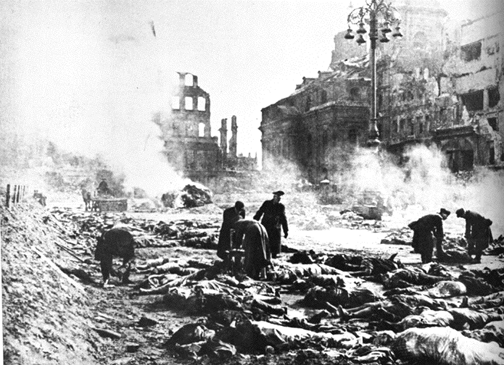
In class I had you pick out scenes from the book that stood out to you for some reason. They were poignant, sad, funny, strange, enlightening, well-written, strangely written, seemingly important, etc.
Discuss at least two scenes you have chosen. Respond to what someone else has said about a third scene. You may write about anything you want--character, characterization, imagery, motifs, historical references, your personal emotional or intellectual reaction, links to other literature we have studied, etc.--as long as you are specific and insightful. (We haven't talked much yet about the novel's motifs but looking at what images, ideas, and phrases are repeated is an excellent clue to what matters in the novel (in any novel, as you probably realize by now).
In addition to writing about what you want, I'd like for you to comment on how the scene (and perhaps the book as a whole) is written. You might deal with the narrator, the narrative voice, the juxtaposition of scenes, the diction, the syntax, etc. Quote directly from the text to illustrate your ideas about the novel!!! "300 words or more" is a good rule of thumb for length. This weekend I'll post another Slaughterhouse-Five assignment and will await your comments. The next post will ask you to think about the novel as a whole.
Sunday, March 30, 2008
Waiting for Godot
Comment insightfully and specifically about Waiting for Godot and about your peers' responses to the play. You may comment all at once or over the course of the week. The comment period will be closed whenever at midnight on Friday, April 4.
Consider writing about the style and form of the play. Consider the minimalist structure. Consider the language.
Consider the stage directions. Consider the label "tragicomedy". Consider the play's relationship to vaudeville comedy. Consider the play's relationship to Theatre of the Absurd.
Consider the play's allusions to Christianity and Christian figures (God-ot, Christ, the thieves, Adam, Cain, Abel, etc.) and to other literature (especially but not exclusively Hamlet).
Consider writing about themes: hope and hopelessness, repetition and variation, sense and senselessness, power and powerlessness, masters and slaves, fate and choice, isolation and connection, waiting and acting (as in action but also as in playing), staying and going, being and not being, and so on.
Consider Samuel Beckett's treatment of the themes in Godot in relation to other author's treatment of the themes in other works you have read and studied.
Consider versions of the scenes from the play in the video bar or explore YouTube on your own. There's a lot there. (Aside: in a professional production of the play that uses Beckett's own production notes, Godot is pronounced GAW-doh and not gud-OH, and Pozzo is pronounced POT-zo not PO-zo. Thought you might be curious.)
Consider your own reaction to the play and explore the reasons for this reaction by remembering our reading of it and by examining the text. Also, push yourself to go beyond your initial reaction.
The best responses will respond to issues we have already discussed and will open up new ground for discussion.
Your response (or responses) should be at least 300 words in length.
Consider writing about the style and form of the play. Consider the minimalist structure. Consider the language.
Consider the stage directions. Consider the label "tragicomedy". Consider the play's relationship to vaudeville comedy. Consider the play's relationship to Theatre of the Absurd.
Consider the play's allusions to Christianity and Christian figures (God-ot, Christ, the thieves, Adam, Cain, Abel, etc.) and to other literature (especially but not exclusively Hamlet).
Consider writing about themes: hope and hopelessness, repetition and variation, sense and senselessness, power and powerlessness, masters and slaves, fate and choice, isolation and connection, waiting and acting (as in action but also as in playing), staying and going, being and not being, and so on.
Consider Samuel Beckett's treatment of the themes in Godot in relation to other author's treatment of the themes in other works you have read and studied.
Consider versions of the scenes from the play in the video bar or explore YouTube on your own. There's a lot there. (Aside: in a professional production of the play that uses Beckett's own production notes, Godot is pronounced GAW-doh and not gud-OH, and Pozzo is pronounced POT-zo not PO-zo. Thought you might be curious.)
Consider your own reaction to the play and explore the reasons for this reaction by remembering our reading of it and by examining the text. Also, push yourself to go beyond your initial reaction.
The best responses will respond to issues we have already discussed and will open up new ground for discussion.
Your response (or responses) should be at least 300 words in length.
Wednesday, March 19, 2008
King Lear/Kind Leer Final Thoughts
Final Work
1. Post again in the thread of comments below. Explore themes. Discuss literary techniques. Quote the text. Make connections to other works of literature. Respond to peers and to ideas from class. Be as thoughtful, insightful, and specific as you would be in a thesis driven paper but allow yourself to be a bit more open and exploratory. (300 words or so.) Due Friday, March 21 by B-block.
2. Write a personal essay on an aspect of King Lear. Start with a quotation. Start with a character. Start with a relationship. Start with an image. Start with a scene. Then reflect on the meaning of this aspect of King Lear in your own life. Be thoughtful. Be specific. Invent an engaging narrative voice and an appropriate essay structure. Observe standard American English writing conventions. I want you to use this essay as an opportunity to fine-tune your sense of composition (a.k.a organization) and your use of language (a.k.a. stylistic resourcefulness and observation of conventions). (600 words or so.) Complete workshop draft due Wednesday, March 26. Final draft due Monday, March 31.
1. Post again in the thread of comments below. Explore themes. Discuss literary techniques. Quote the text. Make connections to other works of literature. Respond to peers and to ideas from class. Be as thoughtful, insightful, and specific as you would be in a thesis driven paper but allow yourself to be a bit more open and exploratory. (300 words or so.) Due Friday, March 21 by B-block.
2. Write a personal essay on an aspect of King Lear. Start with a quotation. Start with a character. Start with a relationship. Start with an image. Start with a scene. Then reflect on the meaning of this aspect of King Lear in your own life. Be thoughtful. Be specific. Invent an engaging narrative voice and an appropriate essay structure. Observe standard American English writing conventions. I want you to use this essay as an opportunity to fine-tune your sense of composition (a.k.a organization) and your use of language (a.k.a. stylistic resourcefulness and observation of conventions). (600 words or so.) Complete workshop draft due Wednesday, March 26. Final draft due Monday, March 31.
Saturday, March 15, 2008
King Lear Acts Four and Five
For your final posts on King Lear I'd like for you all to engage in an "open but guided forum".
So, comment on whatever aspects of the play interest you: characters and characterization, plot and plot design, motifs and themes, imagery and figurative language, poetic form (blank verse, rhyming couplets), comparisons to other works we have studied, performances and staging (in the Brian Blessed King Lear that we have been watching or in the clips from the Laurence Olivier King Lear found in this blog's Video Bar). Be specific. Be insightful. Cite specifics. Think of the whole.
Now here comes the "guided" part: Make sure your name (not just your screen name) is at the beginning of your commentary, deal with at least two direct quotations from the play in your commentary (identify the quotation by referring to act, scene, and lines in this manner: act.scene.lines (e.g. 1.2.33-44), respond substantively to at least one peer in your comments meaning: go beyond saying "I like what x said"), and comment at least twice.
I will grade the commentary according to a slightly modified version of the discussion rubric that we used earlier this year.
The comment period will close at the beginning of B-block on Wednesday, March 19. (I changed my mind about the due date to give you some more time and with the expectation that your comments will be of a high quality. And in case you are thinking "why B-block?" that will be my last opportunity to read comments before class on Wednesday.
So, comment on whatever aspects of the play interest you: characters and characterization, plot and plot design, motifs and themes, imagery and figurative language, poetic form (blank verse, rhyming couplets), comparisons to other works we have studied, performances and staging (in the Brian Blessed King Lear that we have been watching or in the clips from the Laurence Olivier King Lear found in this blog's Video Bar). Be specific. Be insightful. Cite specifics. Think of the whole.
Now here comes the "guided" part: Make sure your name (not just your screen name) is at the beginning of your commentary, deal with at least two direct quotations from the play in your commentary (identify the quotation by referring to act, scene, and lines in this manner: act.scene.lines (e.g. 1.2.33-44), respond substantively to at least one peer in your comments meaning: go beyond saying "I like what x said"), and comment at least twice.
I will grade the commentary according to a slightly modified version of the discussion rubric that we used earlier this year.
The comment period will close at the beginning of B-block on Wednesday, March 19. (I changed my mind about the due date to give you some more time and with the expectation that your comments will be of a high quality. And in case you are thinking "why B-block?" that will be my last opportunity to read comments before class on Wednesday.
Monday, March 10, 2008
King Lear Acts Two and Three
Consider the motifs below and more...
sight (eyes, blindness) and other senses (touch, smell {noses}); fools, madness, and wisdom; duty and betrayal; naturalness and unnaturalness; animals and humans; storms and calms; age and youth; parents and children; rank and status; nothingness, loss, nakedness...& self...
Comment on at least two interrelated motifs. Your comments should refer to at least two specific passages (at least one passage for each motif). Demonstrate your understanding of the play so far by linking the motifs and the passages to each other and to the overall events and themes. Again, we're using close attention to small particulars in order to illuminate the whole.
At the beginning of your post include your name, name the motifs, and quote the passages (include act.scene.line). Your insightful well-supported commentary comes next.
These comments are due by the beginning of class (12:00pm) on Thursday, March 13.
sight (eyes, blindness) and other senses (touch, smell {noses}); fools, madness, and wisdom; duty and betrayal; naturalness and unnaturalness; animals and humans; storms and calms; age and youth; parents and children; rank and status; nothingness, loss, nakedness...& self...
Comment on at least two interrelated motifs. Your comments should refer to at least two specific passages (at least one passage for each motif). Demonstrate your understanding of the play so far by linking the motifs and the passages to each other and to the overall events and themes. Again, we're using close attention to small particulars in order to illuminate the whole.
At the beginning of your post include your name, name the motifs, and quote the passages (include act.scene.line). Your insightful well-supported commentary comes next.
These comments are due by the beginning of class (12:00pm) on Thursday, March 13.
Wednesday, March 5, 2008
King Lear Act One
Respond to at least one of the following in the comments box:
The theme of identity (especially change and disguise) in act one
The theme of nature and naturalness in act one
The motif of "nothing[ness]" in act one
The parallels in the plot and subplot in act one
The use of dramatic irony in act one
The dynamic between parents and children, nobility and servants
or something else you've notice in act one
The theme of identity (especially change and disguise) in act one
The theme of nature and naturalness in act one
The motif of "nothing[ness]" in act one
The parallels in the plot and subplot in act one
The use of dramatic irony in act one
The dynamic between parents and children, nobility and servants
or something else you've notice in act one
Thursday, February 28, 2008
Indirect Characterization in Drama
In the comment box below post a passage of indirect characterization from the play that you read on your own.
Remember that indirect characterization is a tool writers use to imply something about a character without directly stating it. Writers may do this through the character's own actions, speech, and thoughts, as well as through what other characters think and say about the character. What a character looks like and how a character affects others can also contribute to indirect characterization.
The passages you pick should reveal aspects of a character (or characters) without directly stating what those aspects are. Therefore, a perceptive and thoughtful reader should be able to figure out what the author is suggesting without being directly told.
Remember that indirect characterization is a tool writers use to imply something about a character without directly stating it. Writers may do this through the character's own actions, speech, and thoughts, as well as through what other characters think and say about the character. What a character looks like and how a character affects others can also contribute to indirect characterization.
The passages you pick should reveal aspects of a character (or characters) without directly stating what those aspects are. Therefore, a perceptive and thoughtful reader should be able to figure out what the author is suggesting without being directly told.
Monday, February 25, 2008
Bananas & the Importance of Historical Context!
Online Etylmology Dictionary says "Bananas in the slang sense of "nuts"* is first recorded 1935.
Dictionary.com lists 1965-1970 as the period in which "bananas" took on the meaning "crazy, deranged".
As I Lay Dying was published in 1930.
Seems Faulkner wasn't making a joke about Dewey Dell and Vardaman eating bananas instead of going bananas...or if he was his audience wouldn't have gotten the joke.
This is a clear illustration of the importance of knowing what a word meant at the time a work was written. This will be an important consideration when we read King Lear.
*(In case you are wondering, the first recorded use of the word "nuts" to mean "crazy" appears in 1846, which seems to have been derived from the phrase "be nutts upon" meaning "be very fond of" (1785), a use which seems to have been derived from "nuts" meaning "any source of pleasure" (1617).)
Please respond in the comment box if the topic interests you.
Dictionary.com lists 1965-1970 as the period in which "bananas" took on the meaning "crazy, deranged".
As I Lay Dying was published in 1930.
Seems Faulkner wasn't making a joke about Dewey Dell and Vardaman eating bananas instead of going bananas...or if he was his audience wouldn't have gotten the joke.
This is a clear illustration of the importance of knowing what a word meant at the time a work was written. This will be an important consideration when we read King Lear.
*(In case you are wondering, the first recorded use of the word "nuts" to mean "crazy" appears in 1846, which seems to have been derived from the phrase "be nutts upon" meaning "be very fond of" (1785), a use which seems to have been derived from "nuts" meaning "any source of pleasure" (1617).)
Please respond in the comment box if the topic interests you.
Friday, February 15, 2008
Independent Study of Drama
Blog Comments
As you read or after you read, discuss the relationship between any of the following points (your choice) and the play you are reading. Post at least twice on some of the following topics by Tuesday, February 26. Also post at least once in response to a peer's comment. (Three total.)
Themes
* In the plays characters struggle between following personal paths (pursuing a passion, seeking self-understanding, etc.) and serving (following, agreeing with, sacrificing for) their families and/or society. Or, to put it a different way, In the plays families and societies often represent limits against which characters push.
* In the plays characters struggle to understand themselves and their relationships with family and society. Characters often harbor misunderstandings about themselves, their families, and/or their society that are re-examined over the course of the novel often because of dramatic revelations (of secrets, hidden history, etc.) and/or enlightening experiences.
Literary Techniques
While reading look for passages in which the playwright employs indirect characterization. After vacation we'll analyze these passages.
Track at least one object that functions as a motif (perhaps a symbol, perhaps an objective correlative) in the work.
Historical Context
Think about how the time and place (historical context) affect the relationship between individuals' identities, their families, and the society.
As you read or after you read, discuss the relationship between any of the following points (your choice) and the play you are reading. Post at least twice on some of the following topics by Tuesday, February 26. Also post at least once in response to a peer's comment. (Three total.)
Themes
* In the plays characters struggle between following personal paths (pursuing a passion, seeking self-understanding, etc.) and serving (following, agreeing with, sacrificing for) their families and/or society. Or, to put it a different way, In the plays families and societies often represent limits against which characters push.
* In the plays characters struggle to understand themselves and their relationships with family and society. Characters often harbor misunderstandings about themselves, their families, and/or their society that are re-examined over the course of the novel often because of dramatic revelations (of secrets, hidden history, etc.) and/or enlightening experiences.
Literary Techniques
While reading look for passages in which the playwright employs indirect characterization. After vacation we'll analyze these passages.
Track at least one object that functions as a motif (perhaps a symbol, perhaps an objective correlative) in the work.
Historical Context
Think about how the time and place (historical context) affect the relationship between individuals' identities, their families, and the society.
Tuesday, February 12, 2008
Self, Family, and Society
You will read one of the following plays by February 26. You will post responses to the play on the blog.
Title (Author)
Oedipus Rex (Sophocles)*
The Oresteia: Agamemnon, Libation Bearers, and Eumenides (Aeschylus)
Medea (Euripides)**
The Duchess of Malfi (Webster)**
Enemy of the People (Ibsen)**
A Doll’s House (Ibsen) **
The Wild Duck (Ibsen) **
Hedda Gabler (Ibsen) *
Blood Wedding (Lorca)#
Yerma (Lorca)#
House of Bernarda Alba (Lorca)#
Juno and the Paycock (O’Casey)**
Translations (Friel) #
Top Girls (Churchill)
Glass Menagerie (Williams)*
Long Day’s Journey into Night (O’Neill)*
A Touch of the Poet (O’Neill)**
A Moon for the Misbegotten (O’Neill)**
Death of a Salesman (Miller)*
Fences (
The Piano Lesson (
* marks plays that are owned by
** marks plays that are available in the high school library
# marks plays that you could borrow from Mr. Cook
Monday, February 11, 2008
Sophocles' Antigone & Aristotle's Poetics
Read the following questions and passages about Aristotle's Poetics and Sophocles' Antigone. Post comments by with your name, the number of the question you are responding to, and then a response to the question. Due Wednesday.
HAMARTIA IN ANTIGONE
1. What role does "hamartia" play in Antigone? Pay attention to the "complex meaning" of hamartia when answering the question.
2. Where you would lay the blame for the tragedy? Explain. Think about individual blame and inevitable, cosmic fate.
The Greek word that describes what many people refer to as the "tragic flaw" of the hero of Greek tragedy, hamartia has a complex meaning which includes "sin," "error," "trespass," and "missing the mark" (as in archery–missing the bull's-eye). The "mistake" of the hero has an integral place in the plot of the tragedy. The logic of the hero's descent into misfortune is determined by the nature of his or her particular kind of hamartia.
3. Did you feel fear and pity followed by a catharsis when reading Antigone? If not, why not? When responding consider the special meaning of these words in Aristotle's Poetics. (The meanings are explained below.)
4. When have you ever felt fear and pity followed by catharsis when experiencing a work of art (a play, a film, a novel, a poem, a song, a painting, a sculpture, etc.)? Explain. I think, as modern readers, you will find Gadamer's explication (below) of what Aristotle meant by catharsis to be especially helpful and interesting.
FEAR AND PITY
Fear is one of the emotions aroused in the audience of a tragedy. This fear results, Aristotle seems to suggest, when the audience members understand that they, as human beings bound by universal laws, are subject to the same fate that befalls the tragic hero. Fear, along with pity, is "purged" in the process of catharsis. Along with fear, pity is one of the emotions aroused in the audience of a tragedy. We respond with pity, Aristotle seems to suggest, when we as members of the audience identify with the tragic hero's suffering. Pity and fear are "purged" in the process of catharsis.
CATHARSIS
One of the most difficult concepts introduced in the Poetics is catharsis, a word which has come into everyday language even though scholars are still debating its actual meaning in Aristotle's text. Catharsis is most often defined as the "purging" of the emotions of pity and fear that occurs when we watch a tragedy. What is actually involved in this purging is not clear. It is not as simple as getting an object lesson in how to behave; the tragic event does not "teach us a lesson" as do certain public-information campaigns on drunk driving or drug abuse. Hans-Georg Gadamer's attempt to describe catharsis in his study Truth and Method can serve both as a working definition and an introduction into the problem of establishing any determinate definition of this elusive concept:
What is experienced in such an excess of tragic suffering is something truly common. The spectator recognizes himself [or herself] and his [or her] finiteness in the face of the power of fate. What happens to the great ones of the earth has exemplary significance. . . .To see that "this is how it is" is a kind of self-knowledge for the spectator, who emerges with new insight from the illusions in which he [or she], like everyone else, lives. (132){SOURCE for everything above except for the questions: John Zuern's CriticaLink site hosted by the University of Hawai'i}
5. Respond to at least one comment posted by a peer.
Thursday, January 31, 2008
*As I Lay Dying* Literary Analysis Prompt and Rubric
As I Lay Dying Literary Analysis Essay
In a well-organized essay explain how William Faulkner uses literary techniques to convey the existential dilemmas experienced by members of the Bundren family. Also, how do the literary techniques and the existential dilemmas they convey contribute to the meaning and effect of the novel as a whole?
Note #1:
An existential dilemma might be defined as an internal crisis in which one’s own identity, one’s relationship to one’s family and surroundings, and the very nature of existence—the nature of being--are problematic.
Note #2:
Among the literary techniques one might consider are narrative perspective (point of view), style (stream of consciousness and literary lyricism for example), diction, syntax, tone, imagery (symbolic motifs for example), selection of detail (indirect and direct characterization for example), and the juxtaposition of techniques (perspectives, styles, dictions, syntaxes, images, etc.)
Focus on how Faulkner uses the techniques to convey the existential dilemmas (the crises of identity within the characters). Focus on the particularity of the language and its relationship to the novel’s meaning.
AP English Language and Composition 9-point Rubric
for As I Lay Dying Literary Technique Analysis
Essays earning a score of 9 meet the criteria for 8 papers and, in addition, are especially full, apt, sophisticated, insightful, original in their analysis or demonstrate particularly impressive control of language.
Essays earning a score of 8 convincingly and persuasively respond to the prompt. They refer to apt passages text explicitly and implicitly to explain how specific techniques convey the existential crises and contribute to meaning and effect of the novel as a whole. Their prose demonstrates an ability to control a wide range of the elements of effective writing (balance between insightful generalities and supporting details, transition between thoughts, smooth incorporation of quotations and detail, command of syntax and diction) but is not flawless.
Essays earning a score of 7 fit the description of 6 essays but provide a more complete analysis or demonstrate a more mature prose style (see above).
Essays earning a score of 6 adequately respond to the prompt. They convey plausible analysis of the techniques through explicit and implicit references to apt passages in the text, but their discussion is more limited, less convincing. The writing may contain lapses in diction or syntax, but generally the prose is clear.
Essays earning a score of 5 analyze the literary techniques, but they may provide uneven, inconsistent, inaccurate analysis. They may also choose less appropriate passages for support. They may treat the prompt in a superficial way or demonstrate a limited understanding of the prompt. (This might manifest itself in superficial or limited understanding of the techniques and/or the existential dilemmas.) While the writing may contain lapses in diction or syntax, it usually conveys ideas adequately.
Essays earning a score of 4 respond to the prompt inadequately. They may misrepresent the novel’s meaning and effect, show significant or persistent misunderstanding of the passages cited and the characters’ dilemmas, analyze the techniques inaccurately, or offer little discussion of specific techniques. The prose generally conveys the writer's ideas but may suggest immature control of writing.
Essays earning a score of 3 meet the criteria of the score of 4 but are less perceptive about the prompt or less consistent in controlling the elements of writing.
Essays earning a score of 2 demonstrate little success in responding to the prompt. These essays may offer vague generalizations, substitute simpler tasks such as summarizing parts of the novel, offering unsupported generalizations about the characters dilemmas, omitting analysis of specific techniques, or simply listing techniques. The prose often demonstrates consistent weaknesses in writing.
Essays earning a score of 1 meet the criteria for the score of 2 but are undeveloped, especially simplistic in discussion, or weak in their control of language.
Indicates an on-topic response that receives no credit such as one that merely repeats the prompt or one that is completely off topic.
Subscribe to:
Posts (Atom)


